Mosset
Studio Pottery Sculpture Rhinoceros — signed "Mosset", French grès, studio pottery 1970s/80s
Studio Pottery Sculpture Rhinoceros — signed "Mosset", French grès, studio pottery 1970s/80s
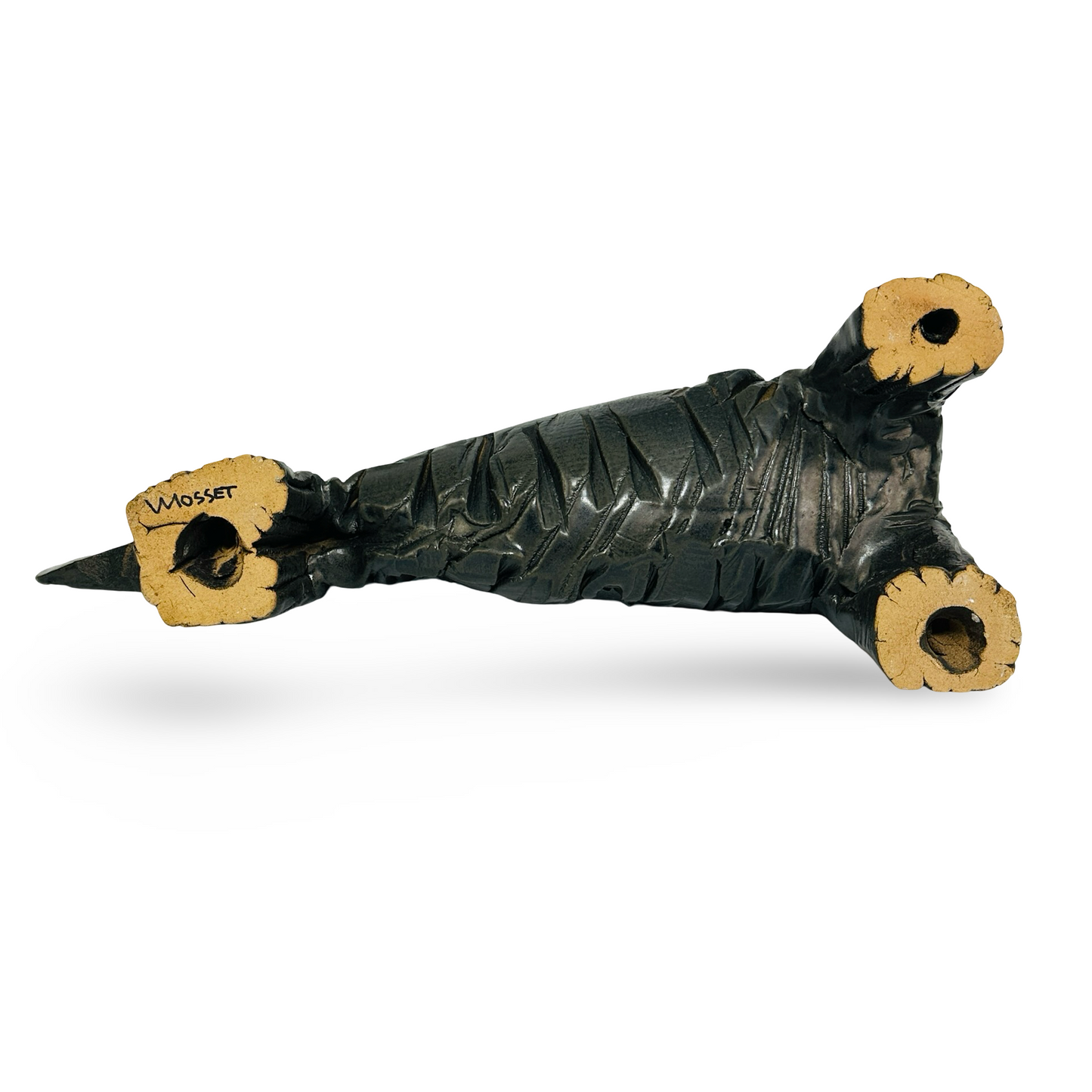
Monumental rhinoceros sculpture made of French grès, hand-built during the workshop period of the 1970s/80s and marked on one of the four legs with the black handwritten signature "Mosset" – an attribution that refers to the pottery village of Mosset in Conflent in the Pyrénées-Orientales at the foot of the Canigou, which has been known for its grès workshops for decades. The massive animal body is built from thick stoneware using slab technique and modeled in a very expressive brutalist formal language: The back bears an erect comb of layered scale plates, the flanks are transformed into a restless, bark-like skin with long, sharp tool nicks and incised lines, and the horn, extended forward with a pointed end, even bears fine carved grooves. The dark blue-black ash glaze with metallic shimmering reflections lies closely over the grès-typical sandstone core, which shines through in a warm ochre on the unglazed foot surfaces – a strong material contrast that makes the haptics of the sculpture immediately tangible.
With a length of 51 cm, a depth of 19.5 cm, and a height of 20 cm, and weighing approximately 5 kg, the sculpture is a monumental object that immediately defines a space – very present on a console, a sideboard, a mantelpiece, or as a sculptural anchor point for a bookshelf. The four legs are hollow due to their construction, with the center of the base and the foot openings clearly showing the unglazed grès shard – a construction feature typical for large-format studio ceramic animals, which first enables drying and high firing without cracking. Very good original condition: no chips, no repaired breaks, the signature clearly preserved, the dark ash glaze with its deep metallic sheen intact. An extraordinary collector's and interior piece in the tradition of French animalier studio ceramics of the 1970s and 80s, in which workshops such as La Borne, Dieulefit, Vallauris, and the small potteries of the Pyrénées-Orientales developed brutalist animal depiction as an independent sculptural genre.
Couldn't load pickup availability